Chaparral
2026
Manzanita Research
Shared roots beneath separate plants. A CLI that symlinks AI coding skills and brand identity across dozens of repos and multiple orgs—because when you're running 40 projects across several brands, copy-paste isn't architecture.
Built with:
I don't work on one or two stable projects. I work in ecosystems of projects riffing off each other—parallel greenfield experiments across multiple brands, multiple clients, constantly spinning up new repos. Manzanita Research, Temple of Silicon, client work. Each brand has its own design language, its own tone of voice, its own aesthetic conventions. I'm Skills-first: for every brand I have skills that specify UI conventions, writing voice, hero image prompting for visual consistency. This is how I keep AI agents aligned with creative intent at scale.
Claude Code discovers skills per-project or globally. There's no org level. People hear that and say "just use the global skills directory." But that's wrong for this workflow. I don't want Manzanita Research's design language leaking into a client project. I want skills scoped to ~/code/org-1/*, ~/code/org-2/*—brand-level, not machine-level. And I need them to propagate instantly, because I'm iterating on the skills themselves as fast as I'm iterating on the projects that use them.
So you end up copying files around. You forget. One repo has the frontend skill from last Tuesday. Another has the version from this morning. The brand voice doc is three versions behind in half your projects and you don't notice until Claude generates something wrong. The more projects you have, the worse it gets. And I have a lot of projects.
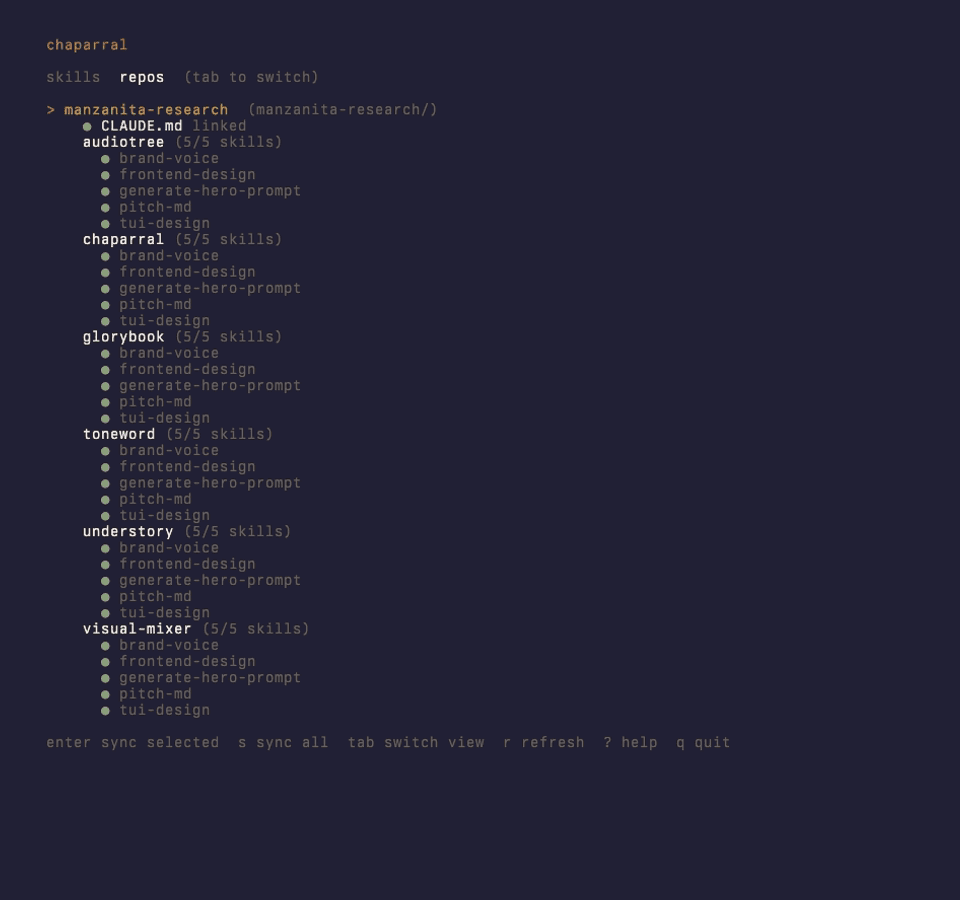
Chaparral is the fix. One brand repo holds shared skills. Run chaparral sync and every sibling repo gets symlinks—not copies, symlinks. Edit a skill once, it's live everywhere instantly. No reinstalls. No cache invalidation. No per-repo setup. The manifest is four lines of JSON. Discovery is automatic.
The mechanics are deliberately simple. Symlinks and a manifest. A TUI dashboard for seeing what's linked, what's stale, what's new. I built it in Go because CLIs should start instantly and ship as a single binary. Bubble Tea for the interface. The whole thing is maybe a thousand lines that does exactly one job well.
Claude Code has a plugin marketplace now, and it's great—for distributing stable skills to other people. But when you're actively developing shared skills across sibling repos, you need something that moves at the speed of thought. Chaparral is your workbench; the marketplace is your storefront. Develop locally with symlinks, then run chaparral publish to push them when they're ready for the world.
The real value isn't the tool. It's what happens when your AI agents share organizational knowledge by default. Skills compound. Brand consistency happens automatically instead of by vigilance. Spinning up a new repo means creating a directory—chaparral handles the rest. The connective tissue becomes invisible, which is the only way it works when you're moving this fast across this many things.
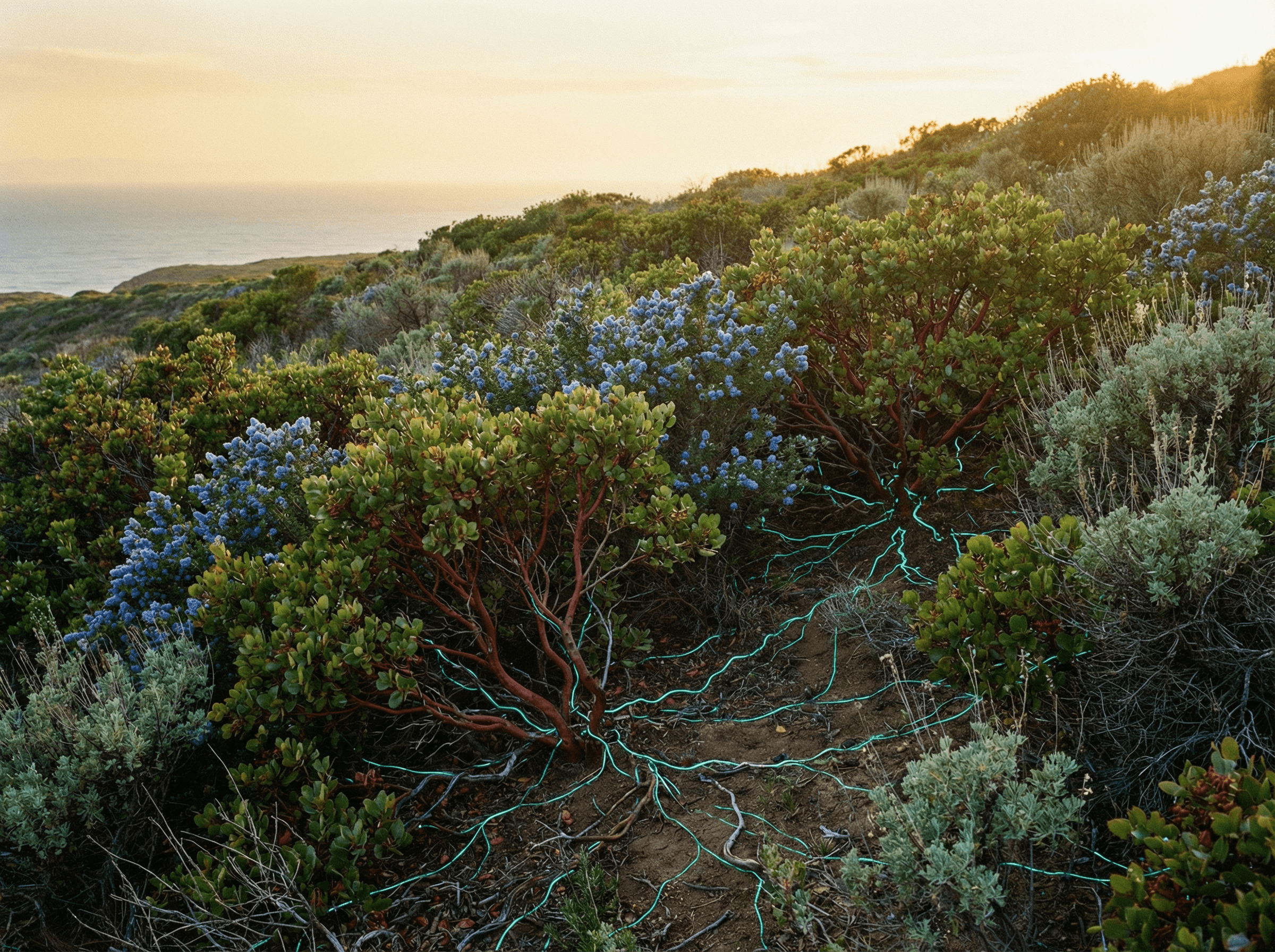
Named for the chaparral—dense, fire-adapted brushland that covers California's coastal hills. Manzanita, ceanothus, sage, toyon. Different plants, same soil, roots intertwined beneath the surface. That's the idea.