ToneWord
2026
Manzanita Research
Say "warmth." Hear warmth. A semantic EQ that replaces frequency knobs with tone words—because guitarists think in feelings, not filter curves. Web app, JUCE plugin, and a stompbox on the way.
Built with:
Every EQ interface works the same way. Frequency. Gain. Q. Drag a node on a curve. Maybe you know that 2.5kHz adds presence. Maybe you're guessing. Either way, you're staring at a graph instead of listening to your guitar.
This has always bothered me. Not because parametric EQ is wrong—it's surgically precise, and that precision matters. But it trains you to shape tone with your eyes. Guitarists don't think in kilohertz. They think in warmth, bite, glass, air. The language is already there. The interfaces just refuse to speak it.
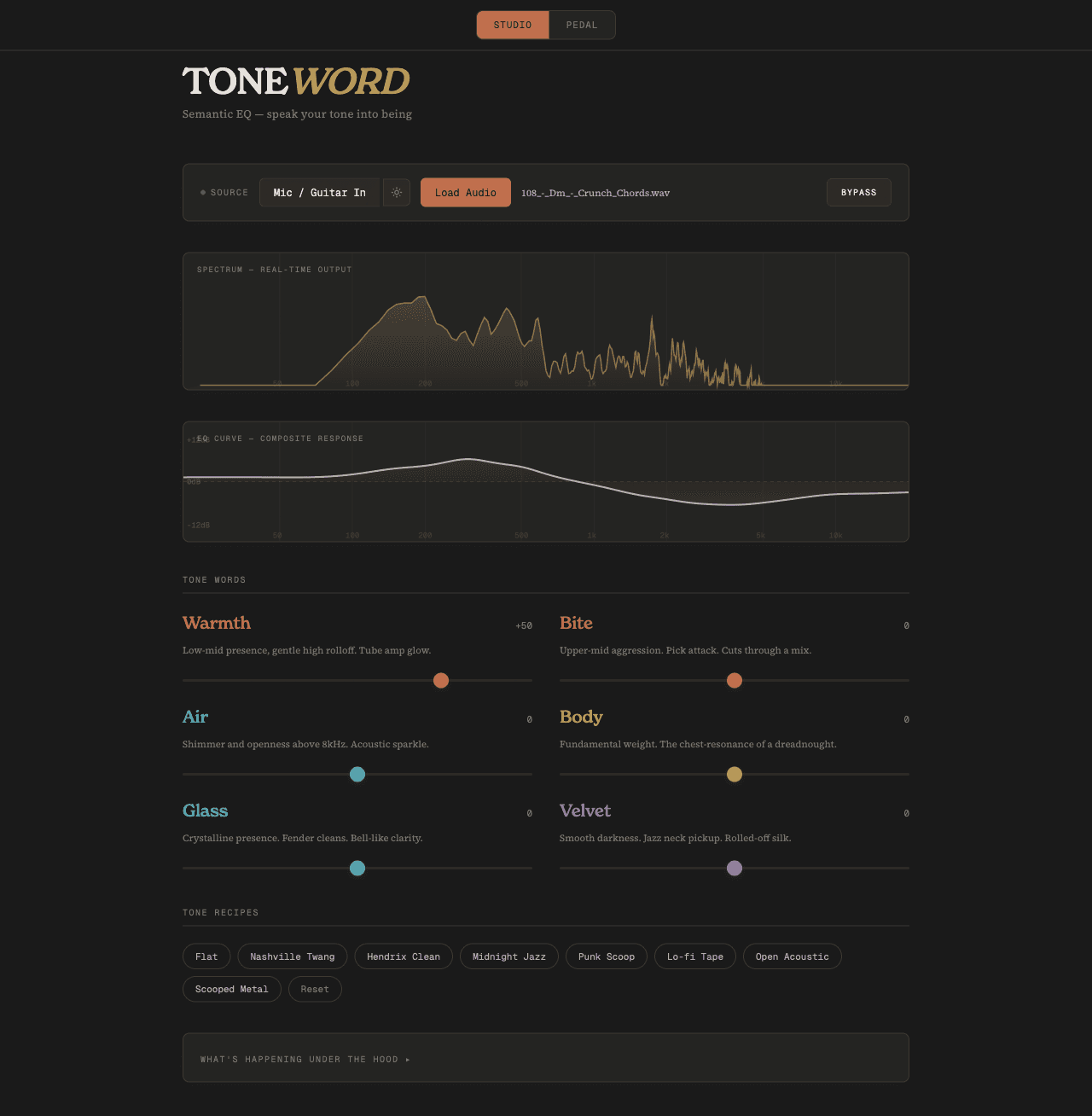
TONEWORD is a semantic EQ. Six perceptual dimensions—Warmth, Bite, Air, Body, Glass, Velvet—each mapped to a complex multi-band EQ curve underneath. Bipolar controls, -100 to +100. Negative Warmth is cold and thin. Negative Bite is smooth and recessed. You describe what you want to hear, and the system translates intent into frequency space.
The interesting part is in the cross-coupling. Boosting Glass automatically attenuates Velvet frequencies, because perceptual brightness and perceptual softness are oppositional—you can't have both at full blast without it turning to mush. The curves interact through soft-clipping via tanh to keep stacked dimensions from producing absurd gains. Eleven parametric bands under the hood, invisible unless you open the teaching panel.
The teaching panel is the bridge. It shows you what "Warmth at +20" actually looks like as an EQ curve—which bands are moving, by how much, and why. The idea is that you start by speaking tone, and over time you internalize what's happening in frequency space. Ears first, eyes to confirm. Not the other way around.
I built the web app first. Runs entirely in the browser via Web Audio API—plug in a guitar or mic, or load a file. Studio mode gives you sliders, a real-time spectrum analyzer, and the teaching panel. Pedal mode gives you a stompbox interface with rotary knobs, because some part of me needed to see this as a piece of gear before I believed it was real.
Then I wrapped it as a JUCE plugin—VST3, AU, Standalone—same DSP engine, native in your DAW. Built on the pamplejuce template, passes pluginval at strictness 10 and auval validation, CI via GitHub Actions. C++ and TypeScript living side by side.
Next up: from the browser to your pedalboard. Because being on stage is the whole point.
Some tools solve a workflow problem. TONEWORD is more like a philosophical argument in code: the best interfaces match the mental model of the person using them, not the implementation model of the system underneath. Guitarists already have a rich, precise language for tone. We just never built the technology to listen to it.